



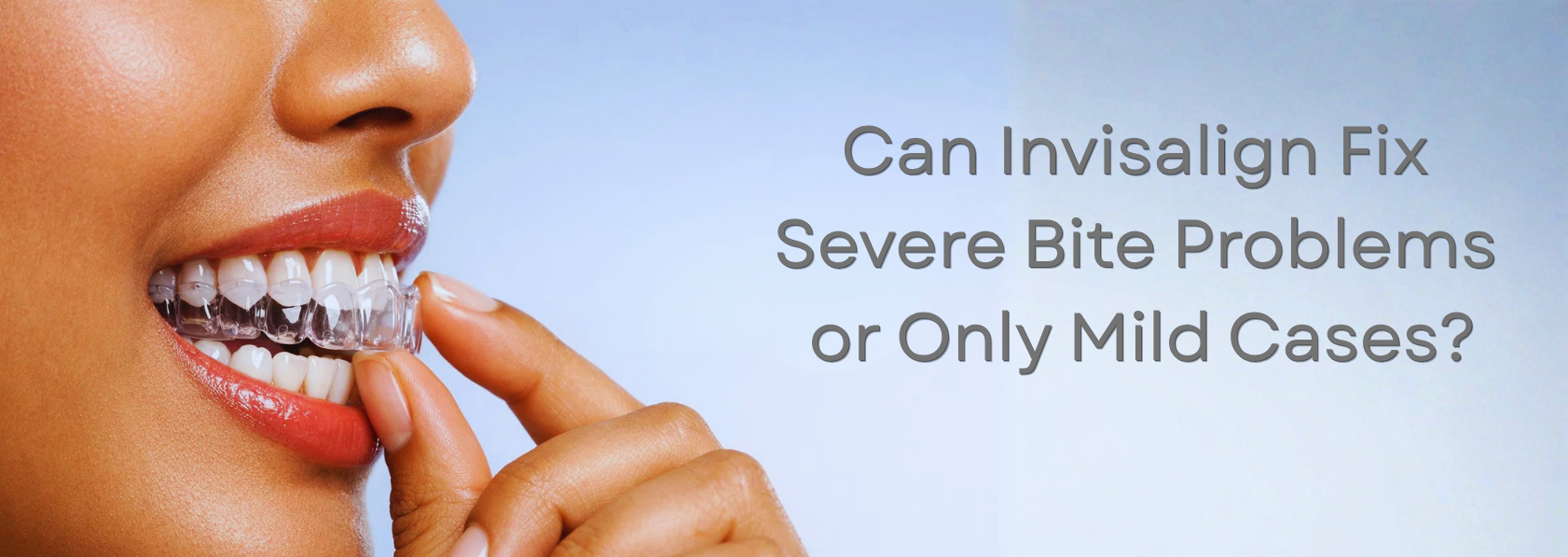
Clear aligners have changed the way people approach orthodontic treatment. With their nearly invisible appearance and convenience, they have become a popular alternative to traditional braces. However, many patients still have an important question: Can Invisalign fix severe bite problems, or is it only suitable for mild cases?
Understanding the capabilities and limitations of Invisalign is essential before making a decision. While aligners have advanced significantly over the years, the effectiveness of treatment depends on several factors, including the severity of the bite issue and the overall treatment plan.
A bite refers to how your upper and lower teeth come together when your mouth is closed. When this alignment is not correct, it can lead to functional issues and discomfort.
Common types of bite problems include:
These conditions can vary from mild to severe and may affect chewing, speech, and jaw comfort
Invisalign has evolved with advanced digital planning and improved aligner design. Today, Invisalign can fix severe bite problems in many cases, especially when the treatment is carefully planned and monitored.
Invisalign uses a series of custom-made aligners that apply controlled force to move teeth gradually. Each set of aligners is designed to bring the teeth closer to their ideal position.
To treat bite problems, orthodontists may use additional tools such as:
These advancements have significantly expanded the range of cases that Invisalign can handle
Invisalign works well for:
For example, many cases of overbite and crossbite can be successfully treated with aligners when guided by an experienced orthodontist.
The more complex the bite problem, the more advanced the treatment approach needs to be. Some cases may require longer treatment or additional techniques.
Modern orthodontics relies heavily on digital planning. A well-designed treatment plan increases the chances of successfully correcting even complex bite issues.
Since aligners are removable, wearing them consistently is essential. Aligners should typically be worn for most of the day to ensure steady progress.
Without proper compliance, even mild cases may not achieve the desired results.
Invisalign offers several benefits that make it appealing to patients:
These features make it a convenient option for both adults and teenagers.
Orthodontic treatment today focuses on both function and long-term stability. While Invisalign is capable of treating many complex cases, the decision should always be based on a detailed evaluation.
Choosing the right approach ensures not just alignment, but also proper jaw function and long-term oral health
So, can Invisalign fix severe bite problems? Yes. With advancements in technology and proper planning, Invisalign can address a wide range of bite issues. The key is to select the treatment that best suits your individual condition rather than focusing on one method alone.If you are dealing with bite issues and considering Invisalign, professional guidance is essential to make the right choice.
Consult Dr. Chetan Agarwal to understand whether Invisalign is suitable for your specific condition.